
Enterprise Wi-Fi problems rarely stem from a lack of hardware. More often, they are caused by weaknesses in network design, security controls or operational processes that have developed over time. As organisations support more cloud applications, hybrid workers and connected devices, enterprise wireless networks must deliver reliable performance without increasing complexity.

The challenge for IT leaders is knowing where to focus first.
The most effective approach to enterprise wireless network management is to prioritise network design, security, visibility, user experience and scalability in that order. Organisations that follow this framework typically see faster performance improvements, stronger security and lower support costs than those pursuing isolated fixes.
What Is Enterprise Wireless Network Management?
Enterprise wireless network management is the process of designing, securing, monitoring and optimising business Wi-Fi infrastructure to ensure users, devices and applications remain connected reliably and securely.
It encompasses every stage of the wireless lifecycle, from planning and deployment through to ongoing monitoring, troubleshooting and performance optimisation. Effective management helps organisations support business-critical applications, maintain security standards and prepare for future growth without compromising user experience.

Why Do Enterprise Wi-Fi Problems Persist?
Many organisations take a reactive approach to wireless networking. New access points are installed when coverage complaints arise, additional bandwidth is purchased when performance slows and security measures are introduced only after vulnerabilities are discovered. While these actions can provide temporary relief, they rarely address the root cause of the problem. In most cases, ongoing enterprise Wi-Fi challenges can be traced back to one of five areas:
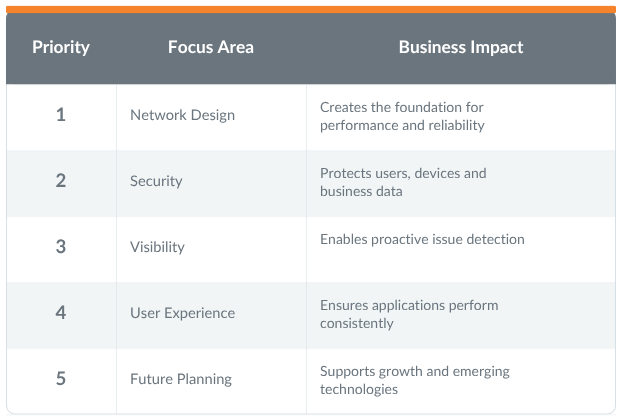
Understanding and addressing these priorities in sequence delivers the greatest long-term value.
1. Fix Network Design Before Anything Else
Why Is Network Design the Most Important Priority?
Network design has a direct impact on every aspect of wireless performance. Poor access point placement, inadequate capacity planning and unmanaged interference can create persistent connectivity issues regardless of how much money is spent on hardware upgrades.
Many organisations assume weak Wi-Fi signals indicate a need for more access points. In reality, adding hardware to a poorly designed environment often increases interference and worsens performance.
A professional wireless site survey should therefore be the first step in any optimisation initiative. This assessment evaluates coverage, signal strength, interference sources, user density and future capacity requirements, providing a clear understanding of how the network performs in real-world conditions.

What Are the Signs of Poor Wi-Fi Design?
Poor network design often reveals itself through recurring user complaints. Employees may experience dropped video calls, inconsistent connectivity when moving around the workplace, slow cloud application performance or unreliable connections in meeting rooms and collaborative spaces.
When these issues occur consistently, the problem is often architectural rather than operational.
The most effective way to improve enterprise Wi-Fi performance is to conduct a wireless site survey and optimise network design. This identifies coverage gaps, interference issues and capacity limitations before organisations invest in additional hardware or software.
2. Strengthen Wireless Security
What Is the Best Security Strategy for Enterprise Wi-Fi?
Once network design has been validated, security becomes the next priority. Enterprise wireless networks provide access to sensitive business systems, cloud applications and corporate data. As a result, they must be protected by layered security controls that verify both users and devices before granting access.
Modern wireless security strategies should incorporate WPA3 Enterprise encryption, identity-based authentication, network segmentation and robust access controls. Together, these measures minimise the risk of unauthorised access and reduce the potential impact of compromised devices.
Organisations should also move away from shared wireless credentials. Individual authentication through Microsoft Entra ID, certificate-based authentication or RADIUS services provides stronger security, greater accountability and improved compliance.
Why Is Network Segmentation Important?
Network segmentation prevents a single compromised device from gaining unrestricted access across the wider organisation. Separating employee devices, guest users, IoT devices and critical business systems create distinct security boundaries that help contain threats and reduce risk exposure.
The best way to secure an enterprise Wi-Fi network is to combine WPA3 Enterprise encryption, network segmentation, identity-based authentication and continuous monitoring to ensure only authorised users and devices can connect.

3. Improve Network Visibility
Why Is Wireless Network Monitoring Important?
Many IT teams discover wireless issues only after employees report them. By that point, productivity may already have been affected. Effective enterprise wireless network management relies on continuous monitoring that provides visibility into network health, performance trends and potential security threats. Real-time monitoring enables teams to identify and resolve issues before they become business problems.
Rather than focusing on isolated metrics, organisations should monitor the overall health of the wireless environment. Connection success rates, roaming efficiency, channel utilisation, authentication failures and access point performance collectively provide a clear picture of network reliability. Advanced monitoring platforms can also identify patterns that would otherwise go unnoticed, helping IT teams reduce troubleshooting time and improve service quality. Enterprise wireless monitoring provides continuous visibility into network performance, security risks and user connectivity, enabling IT teams to resolve issues before they disrupt business operations.
4. Focus on User Experience
How Should Organisations Measure Wireless Performance?
A network can appear healthy from a technical perspective while still delivering a poor experience for end users. For this reason, successful organisations increasingly measure wireless performance through the lens of business outcomes rather than purely technical metrics.
The most meaningful indicators of wireless success are often meeting quality, application responsiveness and employee productivity. If Microsoft Teams calls are reliable, cloud applications respond quickly and users remain connected throughout the working day, the network is delivering value regardless of minor fluctuations in technical metrics.
This user-centric approach helps IT teams align wireless management with broader organisational goals.
The best measure of enterprise Wi-Fi performance is user experience. Organisations should evaluate application responsiveness, collaboration quality and employee productivity rather than relying solely on technical network metrics.

5. Prepare for Future Growth
How Can Organisations Future-Proof Enterprise Wi-Fi?
Enterprise wireless networks must support both current requirements and future demands. User expectations continue to increase as organisations adopt cloud-first strategies, support hybrid workforces and deploy larger numbers of connected devices. At the same time, emerging technologies such as Wi-Fi 6E, Wi-Fi 7 and AI-driven network management are creating new opportunities to improve performance and operational efficiency.
Future-proofing begins with realistic capacity planning. Organisations should regularly assess device growth, bandwidth consumption, application requirements and changing workplace behaviours to ensure the wireless infrastructure can scale without disruption.
Networks designed with future growth in mind typically require fewer emergency upgrades and provide a stronger return on investment over time. Enterprise Wi-Fi networks should be designed to accommodate future growth, emerging wireless standards and increasing device density without requiring major infrastructure changes.
Enterprise Wireless Network Management Checklist
The most successful projects typically follow a simple sequence. Begin by validating network design through a wireless site survey and coverage assessment. Next, strengthen security through modern authentication and segmentation policies. Once the foundations are secure, introduce proactive monitoring to improve visibility and issue detection.
From there, shift attention towards user experience metrics and ongoing capacity planning. This ensures the network continues to support business objectives as technology, applications and workforce requirements evolve.
Why Switchshop?
Switchshop helps organisations design, secure and optimise enterprise wireless networks through wireless surveys, architecture reviews, security assessments and ongoing network management services. By addressing the issues that matter most first, businesses can improve Wi-Fi performance, strengthen security and build a network infrastructure that supports long-term growth.
Frequently Asked Questions
What is enterprise wireless network management?
Enterprise wireless network management is the process of designing, securing, monitoring and optimising business Wi-Fi infrastructure to ensure reliable connectivity, strong security and consistent application performance.
What causes enterprise Wi-Fi problems?
Most enterprise Wi-Fi issues are caused by poor network design, coverage gaps, interference, insufficient capacity planning or weak operational visibility rather than a lack of hardware.
How can organisations improve wireless network performance?
The most effective approach is to conduct a wireless site survey, optimise access point placement, eliminate interference, improve monitoring and ensure network capacity aligns with user demand.
What security measures should enterprise Wi-Fi networks implement?
Enterprise Wi-Fi networks should deploy WPA3 Enterprise encryption, network segmentation, Network Access Control (NAC), certificate-based authentication and continuous monitoring.
Why is proactive wireless monitoring important?
Proactive monitoring enables IT teams to identify performance issues, capacity constraints and security risks before users experience service disruptions.